

Taihape-Napier Road Temporary Closure
Rangitīkei District Council is undertaking resurfacing and rehabilitation work on the Taihape-Napier Road over January and February, motorists should expect delays.
January 07, 2026
One of the rehabilitation jobs requires that the road is closed for six days, from Monday 2 February until Saturday 7 February. The hours of closure are between 6:00am and 6:00pm daily.
During this time, the road will be closed to through traffic between 6:00am and 6:00pm while this work is being undertaken.
Residents will have access for essential travel during the closure but there could be long delays. The road will be open between the hours of 6:00pm and 6:00am during those days, but restrictions will be in place.
Please look to use alternative routes during these planned works.
What are we doing?
Council and our Roading Maintenance Services contractor, Downer NZ, are doing resealing work on the Taihape-Napier Road over summer, as well as some pavement rehabilitation in areas that have significant wear and tear.
In one of the areas where pavement rehabilitation is being done (where the road will be closed from 2-7 February) Downer are using a method called Foam Bitumen Stabilisation. The existing pavement materials of the road is crushed up and mixed with foamed bitumen to create a pavement layer that gets graded and rolled into shape, before finally being chip sealed.
What are the advantages of Foam Bitumen Stabilisation?
- It is quicker than other pavement rehabilitation methods
- It costs less than a full reconstruction of the pavement surface
- Recycles material and has a lower carbon footprint in comparison with other methods
- Has good durability and moisture resistance
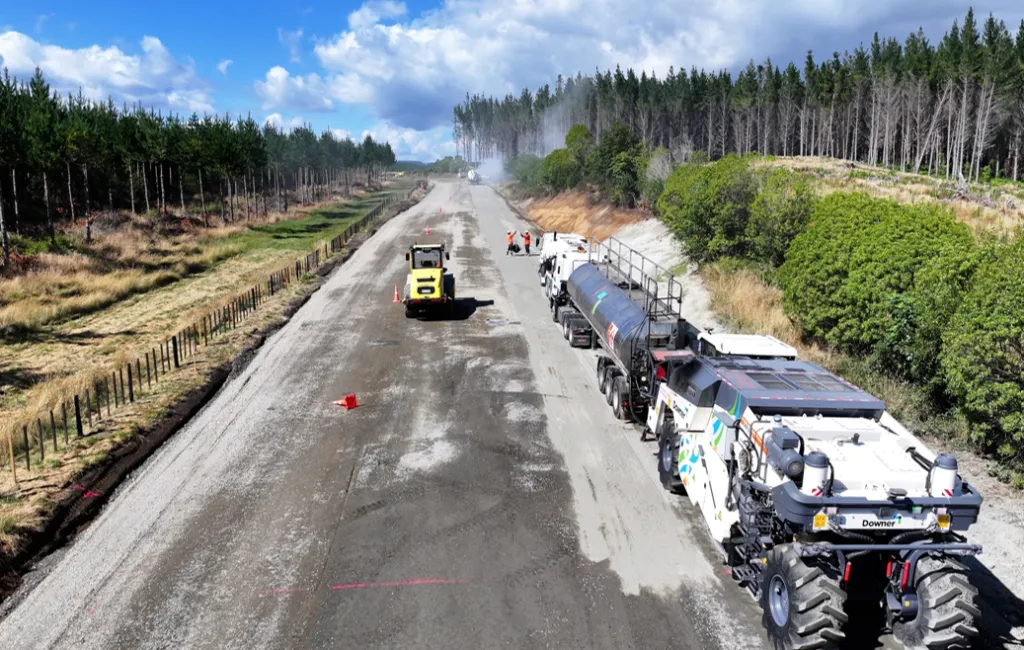
Foam Bitumen Stabilisation involves a "train" machine like this one in the picture above. The machine crushes up the old pavement material and mixes it with foam bitumen to form a new pavement surface. This is then graded and rolled, before being sealed.