

Marton Rail Hub
Council completed the planning and rezoning work needed to unlock future industrial development on the southern edge of Marton, creating opportunities for private investment and economic growth.
PROJECT COMPLETE
Completed: 2025 (Council formally concluded our involvement)
Investment: Available on request.
Project Background
In 2020, Rangitīkei District Council joined with Te Rūnanga o Ngā Wairiki Ngāti Apa, Rangitīkei Forestry Holdings and other partners to explore the development of a rail freight hub on the southern outskirts of Marton.
The proposal aimed to establish Marton as a strategic freight and logistics hub for the lower North Island forestry industry. The vision included transferring more freight from road to rail, supporting regional economic growth, attracting new industry and creating employment opportunities.
As the project developed, Council's primary role became enabling future development through planning, investigations and land-use planning.
This included preparing technical assessments, undertaking environmental investigations, working alongside iwi and stakeholders, and progressing a District Plan change to rezone approximately 65 hectares of land from rural to industrial use.
The proposed rezoning was appealed to the Environment Court, with Council working alongside appellants and interested parties throughout the legal process. In 2023, the Environment Court dismissed the appeal, allowing the rezoning to proceed.
While the original rail hub proposal did not progress as initially envisaged, the work undertaken through the project has created a significant area of industrially zoned land capable of supporting future commercial and industrial investment.
Council's role has now shifted from project delivery to supporting and facilitating private sector investment opportunities on the site.
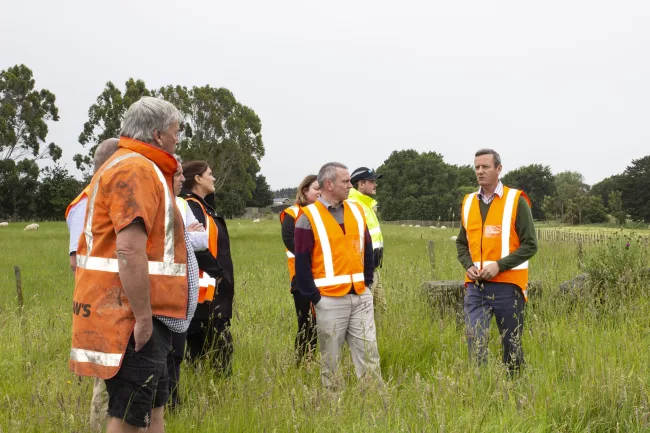
What Changed?
- Approximately 65 hectares of land has been rezoned for industrial development on the southern edge of Marton.
- Extensive planning, environmental and technical investigations have established a strong foundation for future development.
- Council worked alongside iwi, stakeholders and partner organisations throughout the planning process.
- The Environment Court confirmed the industrial rezoning, providing planning certainty for future investors.
- Council's role has transitioned from leading the project to facilitating private investment and economic development opportunities.
The site remains available for future industrial development that supports local employment, business growth and regional economic resilience.
Frequent Asked Questions
The land proposed to accommodate the Marton Rail Hub underwent a district plan change in 2020 to rezone the land from rural to industrial. This was appealed to the Environment Court.
After consideration the Court dismissed the appeal against the proposed plan change in its decision dated 27 April 2023. However, the Council disagreed with certain aspects of this decision which relate to specific provisions of the district plan. The Council has therefore lodged an appeal to the High Court to have these aspects of the decision reconsidered.
The development of the Marton Rail Hub was announced in April 2020 as a partnership between Rangitīkei District Council, Te Rūnanga O Ngā Wairiki Ngāti Apa, the Government’s Infrastructure Reference Group and Rangitīkei Forestry Holdings.
The rail hub, which is set to be based on the outskirts of Marton, will set up the Rangitīkei district as a key logistical hub for the forestry industry across the Lower North Island, allowing handling and transportation of logs by rail to North Island ports. The site will include a de-barking facility and offer space to other relevant industrial businesses.
The land proposed to accommodate the Marton Rail Hub lies to the north of and is parallel to, Makirikiri Road. It is bounded by the main rail trunk line to the west and State Highway 1 to the east.
Access to the development is proposed to be off Makirikiri Road.
Marton is central to significant forests in the Rangitīkei, Manawatū and Horowhenua districts that are mature and will continue to produce mature trees and increased volumes for the next 15 years.
With State Highways 1 and 3 operating as main arterial routes through the district and the proximity to the national rail trunk lines, Marton is well placed to locate a commercial business hub where logs and other materials can access the national rail network for onward transport throughout New Zealand, including the North Island ports for export.
Moving logs and materials by rail rather than road will realise significant environmental, safety and economic benefits, both within the district and nationally.
Marton was built as the rail junction in the North Island to service our agricultural sector; the new rail hub gives the Rangitīkei district the opportunity to start growing again. The idea of the rail hub has been more than three years in the making and the Government has recognised the opportunity this brings to the district. Not only does this recognise the importance of funding key infrastructure in small regional towns, but it will also provide jobs in our local community.
Rangitīkei District Council has estimated that this build, which will include a de-barker facility, will create up to 83 jobs during its construction. When it’s up and running it will enable more efficient log transportation in the lower North Island, as well as create at least 22 full-time jobs.
This rail hub will also attract more commercial developments to the immediate area, thereby creating additional economic benefits and jobs.
The project is supported by a $9.1 million Government investment administered by the Provincial Development Unit (PDU). This investment forms part of the $3 billion infrastructure portion set aside in the Government’s COVID-19 Response and Recovery Fund distributed nationally.
Additional funding sources are being sought to fully fund the development to fully realise the environmental, safety and economic benefits.
Before any further planning can begin, the High Court appeal process must be completed, and the zone change from rural to industrial use confirmed.
Following the conclusion of the appeal process the finalised provisions will need to be reflected in the design. This along with securing the necessary additional funding are key to establishing when the construction could start and when the Marton Rail Hub becomes operational.
The impact of the Marton Rail Hub, both during construction and operationally, has been assessed as part of the Comprehensive Development Plan. These include such things as air quality, noise, lighting, and environmental and visual impacts. These reports can be found above in the appendices linked under 'Plans'.
Rangitīkei District Council is working in close partnership with Te Rūnanga O Ngā Wairiki Ngāti Apa throughout this project. The Council and all stakeholders are committed to honouring the iwi partnership and working collaboratively to enhance collective opportunities within the Rangitīkei district.